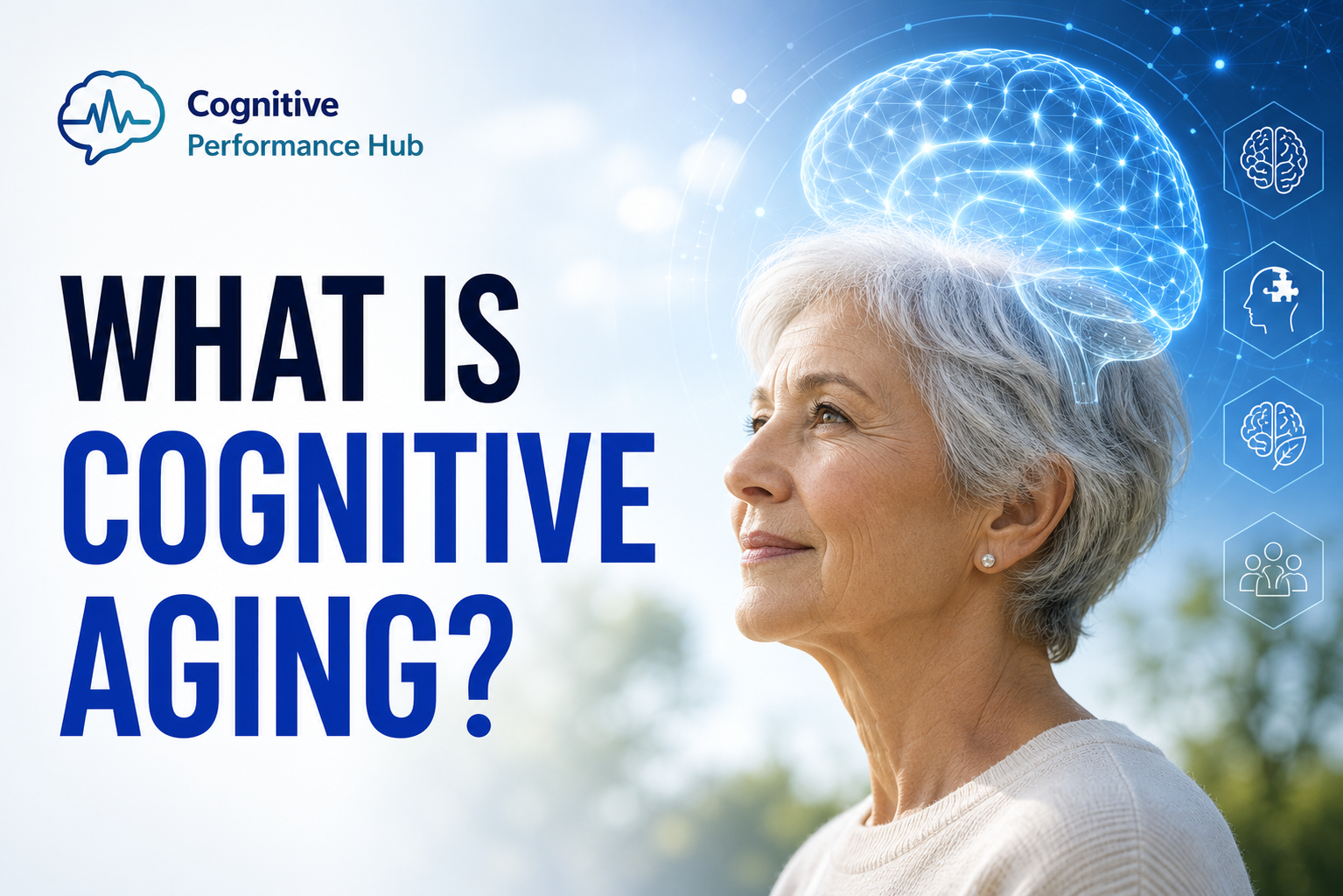
Understanding cognitive aging begins with knowing which changes in memory, focus, and thinking may be a normal part of getting older and which changes may deserve closer attention. This page is part of our Healthy Cognitive Aging pillar, where we explore how brain function can change over time and the practical habits that may help support clarity, memory, and long-term cognitive health.
Cognitive aging refers to the way thinking, memory, learning, attention, and other mental abilities can change over time as we get older. The National Institute on Aging defines cognitive health as the ability to think, learn, and remember clearly, and explains that some changes in thinking are common with age, even in otherwise healthy adults.
Cognitive aging does not mean that serious memory loss or dementia is inevitable. In fact, NIA notes that many older adults experience only modest changes in memory and thinking, and MedlinePlus states that normal aging may cause some forgetfulness but does not lead to dramatic memory loss.
What does cognitive aging actually mean?
Cognitive aging is the gradual change in how the brain processes information over time. It may affect how quickly you find words, how easily you multitask, how fast you learn something new, or how much time you need to remember information. NIA explains that older adults may be slower to find words and recall names, may have more difficulty multitasking, and may experience mild decreases in attention.
At the same time, cognitive aging is not only about decline. NIA also notes that many older adults have larger vocabularies, deeper word knowledge, and the ability to keep learning, form new memories, and improve language skills. Aging brains still retain the ability to change and adapt.
Normal Changes vs Signs to Take Seriously
Some slowing can be part of normal cognitive aging, but loss of function, confusion, or worsening memory problems should not be ignored.
Mild age-related changes
- Taking longer to find words
- Needing more time to learn new information
- Reduced multitasking speed
- Slower recall of names or details
Changes worth checking
- Getting lost in familiar places
- Repeating questions or appointments often
- Trouble with familiar daily tasks
- Confusion that affects independence
Why does the brain change with age?
According to NIA, aging brings changes throughout the body, including the brain. Certain brain regions may shrink, communication between neurons may become less effective, blood flow in the brain may decrease, and inflammation may increase. These changes can influence learning, memory, and other aspects of mental performance, even in healthy older adults.
That does not mean the aging brain stops working well. NIA also emphasizes that the brain can continue adapting to new tasks and challenges. Some people remain exceptionally sharp well into their 80s and 90s, which is one reason researchers study “cognitive super agers” to understand what supports resilience over time.
Aging brains can still stay adaptable
Healthy cognitive aging is not only about decline. Many older adults continue learning, building skills, using stronger vocabulary, and staying mentally engaged for decades.
What factors can affect cognitive aging?
Cognitive aging is shaped by more than age alone. NIA points to a growing brain-body connection, noting that physical health can affect brain health. High blood pressure in midlife and other cerebrovascular risk factors, including diabetes and smoking, are associated with higher dementia risk in observational research.
NIA also cites research suggesting that healthy lifestyle factors such as physical activity, not smoking, not drinking heavily, following a Mediterranean-style eating pattern, and engaging in mentally stimulating activities are associated with lower Alzheimer’s risk. These studies do not prove cause and effect, but they support the idea that lifestyle may influence how the brain ages.
MedlinePlus adds that cognitive impairment can also be related to treatable medical or mental health conditions, including medication side effects, depression, urinary tract infections, hypothyroidism, vitamin B12 deficiency, concussion, and sleep disorders.
3 Core Areas That Support Cognitive Aging
Build your routine around the fundamentals that support memory, focus, and long-term brain health.
Sleep, stress and daily habits
Support brain function with better sleep, lower stress, movement, and steadier routines.
Memory & cognitive function
Explore practical ways to support recall, learning, attention, and mental clarity over time.
Brain health guide
Start with the bigger picture and build a stronger long-term strategy for brain support.
When should someone seek medical advice?
It is worth speaking with a doctor if memory or thinking changes feel new, are getting worse, or are affecting everyday function. NIA advises talking with a doctor if you are concerned about changes in thinking or memory, and MedlinePlus notes that cognitive testing can help identify whether there is a problem that needs further evaluation.
This matters because some causes of cognitive problems may be treatable or reversible. MedlinePlus specifically notes that some causes of cognitive impairment can improve or even resolve with treatment, while dementia-related causes generally worsen over time.
Healthy cognitive aging is about support, not fear
Some slowing can be normal with age, but the brain can remain adaptable for years. The best long-term approach is to stay physically active, protect sleep, support memory, and pay attention to changes that affect everyday life.
Related Articles
- Healthy Cognitive Aging
- Memory & Cognitive Function
- Brain Health Lifestyle
- Brain Health Guide
- Brain Fog
FAQ
What is cognitive aging?
Cognitive aging is the normal way thinking, memory, learning, attention, and other mental functions can change over time as a person gets older.
Is cognitive aging the same as dementia?
No. Dementia is not a normal part of aging. Cognitive aging may involve mild slowing or forgetfulness, while dementia interferes with everyday life and function.
What cognitive changes are normal with age?
Normal changes may include slower word finding, needing more time to learn new information, and more difficulty multitasking.
Can older adults still learn new things?
Yes. NIA notes that older adults can still learn new skills, form new memories, and improve vocabulary and language skills.
What is not normal aging?
Progressive memory loss, confusion, getting lost, or cognitive problems that interfere with daily life are not considered normal aging and should be assessed.
How can I support healthy cognitive aging?
Helpful habits include staying physically active, protecting sleep, staying mentally and socially engaged, and managing cardiovascular and metabolic health.
Support Healthy Cognitive Aging Naturally
Some changes in thinking can be a normal part of aging, but healthy habits still matter. Explore practical strategies for memory, lifestyle, and long-term brain support across the Cognitive Performance Hub.
Sources & References
This page is based on official consumer health information from the National Institute on Aging and MedlinePlus.
Medically Reviewed for Accuracy
This content has been reviewed for accuracy and clarity by the Cognitive Performance Hub Medical Review Team, using current research and evidence-based guidelines.
Our review process ensures that information related to brain health, cognitive performance, and wellness strategies aligns with current scientific understanding and best practices.
Written by Cognitive Performance Hub Editorial Team
Our editorial team consists of health researchers and writers specializing in brain health, cognitive performance, and evidence-based wellness strategies.
We create clear, research-informed content designed to help readers improve focus, enhance memory, reduce brain fog, and support long-term cognitive health.
Brain Health Safety Note
This content is for educational purposes only and should not be used as a substitute for medical advice, diagnosis, or treatment.
If you are experiencing significant memory problems, confusion, sudden cognitive changes, neurological symptoms, or concerns about brain health, speak with a qualified healthcare professional promptly.
Never delay seeking medical advice because of something you read on this site.
Affiliate Transparency
Some pages on Cognitive Performance Hub may include affiliate links. If you choose to make a purchase through one of these links, we may earn a small commission at no extra cost to you.
Our editorial content is created independently and is designed to prioritize clarity, evidence-informed information, and reader value.