
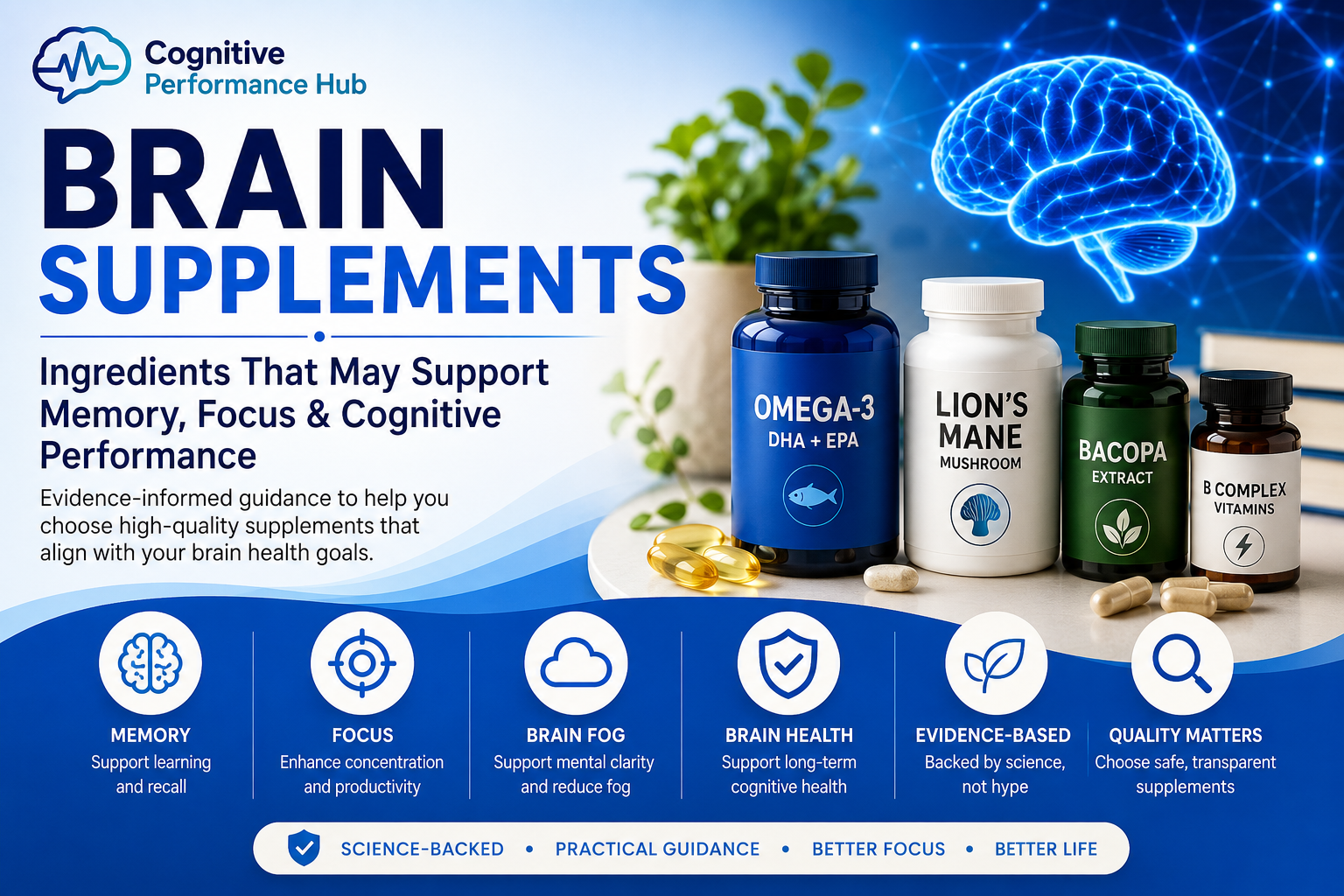
Learn how vitamins, minerals, omega-3 fatty acids, herbs, mushrooms and nootropic ingredients may support memory, focus, mental clarity and long-term brain health—while understanding what current evidence does and does not show.
Brain Supplements Are Only One Part of Brain Health
Supplements may be useful in selected situations, but their potential value depends on the ingredient, dosage, product quality, individual needs and the strength of the wider brain-health foundation.
Brain supplements are now widely available, ranging from simple omega-3 capsules and individual vitamins to complex nootropic blends promising sharper focus, stronger memory and sustained mental energy.
Some ingredients have been studied for specific aspects of cognition or nutritional support. However, supplements should not be treated as shortcuts, guaranteed cognitive enhancers or replacements for proper medical assessment.
For most readers, the strongest foundation remains consistent sleep, regular movement, balanced nutrition, stress management, social engagement and appropriate healthcare.
What Are Brain Supplements?
Brain supplements are dietary supplements marketed to support memory, attention, mental clarity, alertness, mood or healthy cognitive aging.
Depending on the product, formulas may include vitamins, minerals, omega-3 fatty acids, herbal extracts, amino acids, mushrooms, phospholipids or multi-ingredient nootropic blends. These categories differ considerably in purpose, evidence quality and safety.
Memory Support
Products marketed for learning, recall and healthy cognitive aging.
Focus and Attention
Ingredients promoted for concentration, productivity and mental clarity.
Mental Energy
Products marketed for alertness, endurance and reduced mental fatigue.
Stress Resilience
Ingredients intended to support calm, mood or adaptation to stress.
Set Realistic Expectations Before Choosing a Supplement
Outcomes vary according to the ingredient, dosage, nutritional status, underlying health, medication use and product quality.
What They May Help With
- Addressing a confirmed nutritional deficiency
- Supporting a clearly defined cognitive goal
- Complementing healthy daily habits
- Supporting general nutritional adequacy
- Adding targeted support in selected situations
What They Cannot Do
- Replace healthy sleep or nutrition
- Guarantee better memory or concentration
- Reverse dementia or neurological disease
- Replace professional diagnosis or treatment
- Compensate for every underlying health issue
Quick Takeaway
The most useful way to think about brain supplements is as support tools, not miracle solutions. They make the most sense when matched to a specific goal and used alongside healthy sleep, nutritious food, regular movement, stress management and appropriate medical care.
Who May Consider Brain Supplements?
Brain supplements are not appropriate or necessary for everyone. People usually explore them because of a specific cognitive goal, nutritional concern or interest in long-term brain health.
Students and Learners
Some students investigate supplements during periods of intensive study, although sleep, nutrition, exercise and stress management usually have a greater influence on learning and mental endurance.
Busy Professionals
Working adults may explore products intended to complement healthy routines during mentally demanding workdays or periods of sustained concentration.
Healthy Cognitive Aging
Older adults may investigate targeted nutrients or supplements as one part of a wider strategy that includes physical activity, nutritious food, social engagement and appropriate healthcare.
General Wellness
Some people simply want to support overall brain health alongside balanced nutrition, regular exercise, consistent sleep and other sustainable habits.
Choose the Brain Supplement Path That Matches Your Goal
Instead of choosing products randomly, begin with the outcome you want to understand and use the most relevant evidence-informed guide.
Support Memory
Explore ingredients commonly researched for memory, learning, recall and healthy cognitive aging.
Best Memory Supplements →Improve Focus
Compare nootropics and nutrients commonly discussed for attention, concentration, productivity and mental clarity.
Best Nootropics for Focus →Understand Brain Fog
Review supplements often discussed for mental fatigue, reduced clarity and feelings of cognitive sluggishness.
Brain Fog Supplements →Compare Products
Browse evidence-informed reviews covering ingredients, claims, transparency, safety considerations and value.
Read Supplement Reviews →Build Your Brain Health Foundation First
Even a well-formulated supplement cannot fully compensate for consistently poor sleep, high stress, physical inactivity, inadequate nutrition or untreated health problems. Strengthen the fundamentals before expecting a supplement to make a meaningful difference.
Sleep
Consistent, restorative sleep supports attention, learning, memory and emotional regulation.
Exercise
Regular physical activity supports circulation, mood, sleep quality and overall brain health.
Nutrition
A balanced eating pattern provides the nutrients and steady energy the brain depends on.
Stress Management
Managing persistent stress may support concentration, memory, sleep and everyday mental wellbeing.
Major Types of Brain Supplements
Brain supplements include many different ingredient types, proposed mechanisms and intended uses. Evidence should be evaluated at the individual ingredient and dosage level—not only by the broader category.
Omega-3 Fatty Acids
Omega-3 fatty acids—particularly DHA and EPA—are important components of normal cell membranes and have been widely studied in relation to brain, heart and general health.
Research is more supportive of their nutritional and physiological roles than of guaranteed short-term improvements in memory or focus.
Vitamins
B vitamins, vitamin D and other nutrients contribute to normal nervous-system function, energy metabolism and general health.
Supplementation is generally most relevant when intake is low or a deficiency has been identified. Benefits are less certain when nutritional status is already adequate.
Minerals
Magnesium, zinc, iron and other minerals participate in many biological processes involving nerve signalling, energy production and overall health.
As with vitamins, correcting inadequate intake or a diagnosed deficiency is usually more relevant than indiscriminate use.
Herbal Ingredients
Common examples include Ginkgo biloba, Bacopa monnieri, Rhodiola rosea and Ashwagandha. These ingredients are marketed for memory, stress resilience, mood or mental performance.
Evidence differs considerably between herbs, extracts, dosages and study populations.
Medicinal Mushrooms
Lion’s Mane and other mushroom-derived products have attracted growing interest for potential effects on nerve health, mood and cognitive function.
Human evidence remains limited compared with the amount of laboratory, animal and marketing attention these products receive.
Amino Acids and Related Compounds
Ingredients such as L-theanine, tyrosine and related compounds are sometimes used alone or combined with caffeine in products marketed for calm alertness, stress or cognitive performance.
Effects depend on the ingredient, dosage, timing and the situation in which it is used.
Nootropics
“Nootropic” is a broad marketing term used for ingredients and formulas intended to support cognition, focus, memory or mental performance.
Products may combine vitamins, herbs, amino acids, mushrooms, stimulants or other compounds, so quality and evidence can differ substantially.
Combination Formulas
Commercial brain supplements frequently combine several ingredients to target memory, focus, mood and mental clarity in one product.
More ingredients do not automatically produce better results. Proprietary blends and undisclosed dosages can also make formulas difficult to evaluate.
Quick Comparison of Brain Supplement Categories
This overview summarises the common role of each category. It does not replace evaluation of the specific ingredient, dosage, evidence and safety profile.
Swipe sideways to view the full comparison table.
| Category | Common Goal | Evidence Context | Most Relevant When |
|---|---|---|---|
| Omega-3 fatty acids | General brain and nutritional support | Established nutrient role; cognitive outcomes vary | Dietary intake is low or targeted use is appropriate |
| Vitamins | Nervous-system and nutritional support | Stronger when correcting deficiency | A deficiency or inadequate intake is identified |
| Minerals | Normal nerve and metabolic function | Depends on mineral and nutritional status | Intake is inadequate or deficiency is confirmed |
| Herbal ingredients | Memory, stress, mood or focus | Mixed and ingredient-specific | A clearly researched extract and dosage are used |
| Medicinal mushrooms | Emerging cognitive or nerve-health support | Limited and developing human evidence | Expectations remain cautious and safety is reviewed |
| Amino acids | Alertness, stress or situational performance | Varies by compound and context | The ingredient matches a specific, researched use |
| Nootropics | Focus, memory or productivity | Highly variable | The formula is transparent and individually assessed |
| Combination formulas | Multiple cognitive goals | Product- and dosage-dependent | Every ingredient and amount is clearly disclosed |
Why Evidence Quality Matters
Not all brain supplements have the same level of scientific support. Some nutrients have well-established biological roles, while other ingredients rely on small studies, short trials, laboratory research or inconsistent findings.
Results may also depend on the dosage, extract quality, participant characteristics, study duration, baseline nutritional status and the outcome being measured.
Cognitive Performance Hub prioritises evidence quality over popularity and marketing claims. Our guides explain where findings are reasonably supportive, where they remain mixed and where realistic expectations are especially important.
How to Choose a High-Quality Brain Supplement
Ingredient quality, dosage transparency, manufacturing standards and scientific support can differ significantly between products. Use the checks below before deciding what deserves further consideration.
Transparent Ingredient Labels
Look for products that clearly identify every active ingredient and its amount per serving. Full disclosure makes formulas easier to compare and evaluate.
Meaningful Ingredient Dosages
A product may advertise a researched ingredient while providing a much smaller amount than the dosage used in human studies. Compare label amounts with relevant research where practical.
Reputable Manufacturing
Prefer companies that provide clear contact details, describe how their products are made and follow recognised manufacturing or quality-control standards.
Independent Quality Testing
Credible third-party verification may improve confidence in identity, purity and label accuracy. It does not prove that a supplement will produce the advertised benefit.
Relevant Human Research
Marketing claims and testimonials are weak forms of evidence. Give greater weight to peer-reviewed human studies using a comparable ingredient, extract and dosage.
Professional Safety Advice
Speak with a doctor or pharmacist before starting a supplement if you take medication, have a medical condition, are pregnant, breastfeeding or preparing for surgery.
Common Brain Supplement Red Flags
Be cautious when products rely on dramatic promises, unclear formulas or persuasive marketing instead of transparent evidence.
Miracle or Disease Claims
Avoid products claiming to permanently increase IQ, reverse aging, cure dementia or treat neurological disease.
Undisclosed Proprietary Blends
Blends that hide individual ingredient amounts make it difficult to judge dosage, effectiveness and safety.
Testimonials Presented as Proof
Personal success stories may be selective, exaggerated or fabricated and do not replace controlled human research.
Unverifiable Professional Endorsements
Be cautious of vague “doctor recommended” wording when no named, qualified or verifiable professional is identified.
Guaranteed Cognitive Results
No supplement can guarantee better memory, focus, productivity or mental clarity for every person.
Incomplete Safety Information
Avoid products that hide ingredients, omit warnings or make it difficult to identify the company responsible.
Before Buying Any Brain Supplement
Use this six-step process to slow down the decision and separate useful information from persuasive marketing.
Define Your Goal
Decide whether your priority is memory, focus, brain fog, nutritional support or healthy cognitive aging.
Research the Ingredients
Review what each ingredient is intended to do and how strong the evidence is for that outcome.
Compare the Formulas
Compare ingredient forms, amounts, serving sizes, testing, transparency and total cost.
Review Safety
Consider medication use, allergies, medical conditions, pregnancy, surgery plans and overlapping ingredients.
Set Realistic Expectations
Supplements may complement healthy habits, but should not replace sleep, nutrition, exercise or medical care.
Read Independent Analysis
Use balanced reviews that examine evidence, transparency, safety and value—not only customer testimonials.
Compare Brain Supplements Before Spending Your Money
Our review centre examines product formulas, ingredient evidence, label transparency, safety considerations, marketing claims and value so readers can make more informed purchasing decisions.
Brain Supplement Learning Centre
Explore evidence-informed guides and product reviews based on your goals. These resources examine ingredients, research, transparency, safety considerations and realistic expectations.
Goal-Based Supplement Guides
Best Memory Supplements
Compare ingredients commonly researched for learning, recall, memory support and healthy cognitive aging.
Explore Memory Guide →Best Nootropics for Focus
Review nootropics and brain-support ingredients discussed for concentration, productivity and mental clarity.
Explore Focus Guide →Best Brain Fog Supplements
Examine ingredients commonly discussed for mental sluggishness, fatigue and reduced cognitive clarity.
Explore Brain Fog Guide →Brain Supplement Reviews
Brain Supplement Review Hub
Browse the complete library of supplement reviews and product analyses in one organised location.
Browse All Reviews →Neuro Zoom Review
Review Neuro Zoom’s ingredients, claims, label transparency, evidence and overall buying considerations.
Read Neuro Zoom Review →CogniClear Review
Explore CogniClear’s ingredient profile, product claims, evidence, safety considerations and verdict.
Read CogniClear Review →NeuroPrime Review
Independent analysis of NeuroPrime’s formula, scientific support, product transparency and practical value.
Read NeuroPrime Review →Neuro Serge Review
Examine Neuro Serge’s ingredients, evidence, label transparency, safety considerations and product positioning.
Read Neuro Serge Review →Synaptigen Review
Review Synaptigen’s ingredients, advertised benefits, evidence, transparency and value considerations.
Read Synaptigen Review →The Best Supplement Is One That Matches Your Needs
There is no single best brain supplement for everyone. The most appropriate option depends on your goal, nutritional status, medical history, medications, allergies, product quality and the strength of the evidence for the ingredient being considered.
Whenever possible, build your foundation through quality sleep, exercise, balanced nutrition, hydration and stress management before expecting supplements to produce meaningful results.
Seek advice before using supplements if you take prescription medication, have a chronic medical condition, are pregnant, breastfeeding, preparing for surgery or experiencing persistent or worsening cognitive symptoms.
Choose Your Next Supplement Resource
Continue with the evidence-informed guide or review collection that most closely matches your current brain-health goal.
Memory Support
Compare ingredients commonly researched for learning, recall, memory support and healthy cognitive aging.
Explore Memory SupplementsFocus and Productivity
Explore nootropics and nutrients commonly discussed for attention, concentration, productivity and mental clarity.
Explore Focus NootropicsBrain Fog Support
Review ingredients commonly discussed for mental fatigue, cognitive sluggishness and reduced mental clarity.
Explore Brain Fog SupplementsBrain Supplement Reviews
Compare product formulas, ingredient evidence, label transparency, safety considerations and overall value before buying.
Browse Supplement ReviewsKey Takeaways About Brain Supplements
Brain supplements may be useful in selected circumstances, but their value depends on the ingredient, dosage, evidence, product quality, personal health context and the strength of your wider brain-health foundation.
Start With a Specific Goal
Memory, focus, brain fog, stress resilience and nutritional support are different goals and may require different approaches.
Correcting a Deficiency May Matter Most
Vitamins and minerals are generally most relevant when they address inadequate intake or a confirmed nutritional deficiency.
Evidence Varies by Ingredient
Omega-3s, vitamins, herbs, mushrooms, amino acids and commercial nootropic formulas do not have the same quality or quantity of scientific support.
More Ingredients Do Not Guarantee Better Results
Large formulas may appear impressive while using unclear, overlapping, underdosed or difficult-to-evaluate ingredient combinations.
Transparent Labels Are Easier to Assess
Clearly disclosed ingredient amounts, manufacturing information and credible quality testing make comparison more practical.
Natural Does Not Automatically Mean Safe
Supplements can cause side effects or interact with medicines, health conditions, surgery and other products.
Introduce One Product at a Time
Trialling products separately may make it easier to recognise possible benefits, side effects or ingredients that offer no noticeable value.
Lifestyle Foundations Still Come First
Sleep, movement, nutritious food, hydration, stress management and appropriate healthcare remain central to brain health.
Frequently Asked Questions About Brain Supplements
Clear answers to common questions about ingredients, effectiveness, product quality, everyday use, safety and realistic expectations.
What are brain supplements?
Brain supplements are dietary supplements marketed to support memory, focus, mental clarity, alertness, cognitive performance or healthy cognitive aging. They may contain vitamins, minerals, omega-3 fatty acids, herbs, amino acids, mushrooms or multi-ingredient nootropic formulas.
Do brain supplements really work?
Some supplements may help in specific circumstances, particularly when they correct a nutritional deficiency or use an ingredient with supportive evidence for a defined outcome. Results vary by person, ingredient, dosage and product quality, and no supplement works for everyone.
What is the best supplement for memory?
There is no single best memory supplement for everyone. The most appropriate option depends on age, diet, nutrient status, medication use, health conditions and the reason memory support is being considered.
Are omega-3 supplements good for the brain?
Omega-3 fatty acids have important physiological and nutritional roles and may be particularly relevant when oily-fish intake is low. Evidence for broad cognitive improvement from supplementation is mixed and depends on the population, dosage and outcome studied.
Is ginkgo biloba effective for cognitive decline?
Current evidence does not support presenting ginkgo biloba as a proven way to prevent or reverse dementia or cognitive decline. It remains widely marketed, but expectations should remain cautious.
Can vitamin B12 affect memory and mental clarity?
Vitamin B12 deficiency can affect neurological function, energy and cognition. For someone who is deficient, identifying and correcting that deficiency may be more relevant than taking a broad nootropic formula.
Are brain supplements safe to take every day?
Not necessarily. Safety depends on the ingredient, dosage, duration, medication use, medical conditions, pregnancy status, surgery plans and product quality. Daily use should not automatically be assumed to be appropriate.
How do I choose a high-quality brain supplement?
Look for clearly disclosed ingredient amounts, realistic claims, reputable manufacturing information and meaningful quality-control details. Independent verification may add confidence in product quality, although it does not prove effectiveness.
Are multivitamins useful for cognitive aging?
Some studies have reported modest cognitive or memory findings in selected older-adult populations. These results do not mean that multivitamins are proven to prevent cognitive decline or are necessary for every adult.
Should supplements replace diet and lifestyle changes?
No. Supplements cannot replace the variety of nutrients and broader benefits provided by nutritious food, quality sleep, physical activity, stress management and appropriate medical care.
Can brain supplements interact with medication?
Yes. Some supplements may interact with blood thinners, antidepressants, diabetes medicines, heart medicines, sedatives and other prescriptions. A doctor or pharmacist can help assess possible interactions.
What is the safest way to trial a brain supplement?
Review safety and possible interactions first, use one product at a time, follow label directions, avoid stacking several complex formulas and stop using the product if concerning side effects develop.
Make More Informed Brain Supplement Decisions
Whether you are researching memory supplements, focus nootropics, brain fog formulas or popular supplement brands, our guides and reviews can help you better understand the evidence before buying.
References & Scientific Sources
This guide draws on government health resources, systematic reviews, peer-reviewed research databases and evidence summaries covering dietary supplements, nutrition, cognitive health and healthy aging.

Medically Reviewed for Accuracy
This content has been reviewed for accuracy and clarity by the Cognitive Performance Hub Medical Review Team, using current research and evidence-based guidelines.
Our review process ensures that information related to brain health, cognitive performance, and wellness strategies aligns with current scientific understanding and best practices.
Written by Cognitive Performance Hub Editorial Team
Our editorial team consists of health researchers and writers specializing in brain health, cognitive performance, and evidence-based wellness strategies.
We create clear, research-informed content designed to help readers improve focus, enhance memory, reduce brain fog, and support long-term cognitive health.
Brain Health Safety Note
This content is for educational purposes only and should not be used as a substitute for medical advice, diagnosis, or treatment.
If you are experiencing significant memory problems, confusion, sudden cognitive changes, neurological symptoms, or concerns about brain health, speak with a qualified healthcare professional promptly.
Never delay seeking medical advice because of something you read on this site.
Affiliate Transparency
Some pages on Cognitive Performance Hub may include affiliate links. If you choose to make a purchase through one of these links, we may earn a small commission at no extra cost to you.
Our editorial content is created independently and is designed to prioritize clarity, evidence-informed information, and reader value.