Part of the Brainwave Entrainment pillar in the Brain Health Hub.
The human brain is constantly producing tiny electrical signals that can be measured using electroencephalography (EEG). These patterns, known as brain waves, vary in frequency depending on what you are doing, how alert you feel, and your current mental state.
Brain waves are commonly grouped into five main frequency bands:
- Delta
- Theta
- Alpha
- Beta
- Gamma
Each range is associated with different patterns of brain activity, although it is important to remember that the brain rarely operates in only one frequency at a time. Instead, several wave types are usually present together, with one becoming more dominant depending on the situation.
This guide explains what each brainwave frequency represents, how scientists measure them, and why they are often discussed in relation to focus, meditation, relaxation, sleep and brainwave entrainment.
Brainwave Frequencies at a Glance
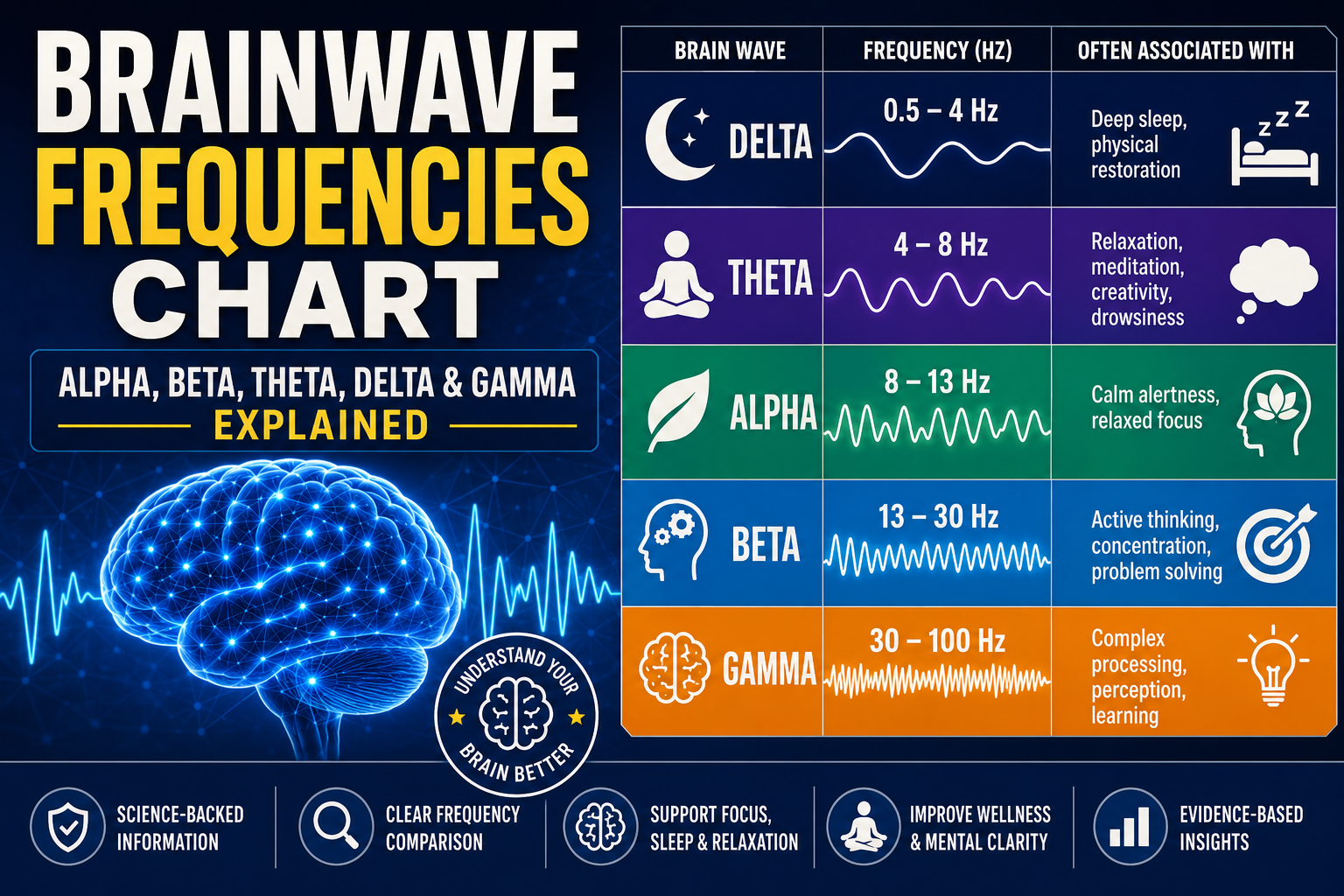
Brainwave bands move from slower Delta activity to faster Gamma activity. The ranges below are approximate, and several frequency bands can be present across the brain at the same time.
Delta
Deep sleep and restorative slow-wave activity.
Theta
Drowsiness, light sleep, inward attention and meditation.
Alpha
Calm wakefulness, relaxed alertness and quiet rest.
Beta
Active thinking, conversation, planning and concentration.
Gamma
High-level processing, attention and information integration.
Important: These are broad EEG categories, not rigid mental-state switches. A person can display activity across several bands simultaneously.
How Are Brain Waves Measured?
Brain waves are measured using electroencephalography (EEG), which records tiny electrical signals produced by groups of neurons communicating with one another.
EEG does not read thoughts or intelligence. Instead, it measures patterns of electrical activity occurring across different regions of the brain.
Related Page: Brain Waves Explained: Alpha, Beta, Theta, Delta and Gamma
How the Main EEG Frequency Bands Compare
Slower brainwave bands complete fewer cycles per second, while faster bands complete more. The waveform illustrations below are simplified visual examples rather than actual EEG recordings.
These waveform shapes are illustrative only. Real EEG signals are more irregular and are interpreted in relation to brain region, age, state, clinical context and recording conditions.
Delta Waves (0.5–4 Hz)
Delta waves are the slowest brain waves typically observed in healthy adults.
They are most strongly associated with deep, dreamless sleep and restorative processes.
Higher delta activity while awake may occur under certain medical conditions, but during healthy waking hours delta activity is generally much lower.
Related Page: Binaural Beats for Sleep: What to Know Before You Try Them
Theta Waves (4–8 Hz)
Theta waves are commonly linked with light sleep, drowsiness, meditation, daydreaming and some forms of creativity.
Many meditation recordings and relaxation programs discuss theta frequencies, although researchers continue studying exactly how different audio methods influence brain activity.
Related Page: Brainwave Entrainment for Meditation and Calm
Alpha Waves (8–13 Hz)
Alpha waves are often associated with calm wakefulness.
People commonly exhibit stronger alpha activity while resting quietly with their eyes closed but remaining awake and alert.
Alpha is frequently discussed in relation to relaxed concentration and stress reduction.
Beta Waves (13–30 Hz)
Beta waves become more prominent during active thinking, conversation, planning, decision making and mentally demanding tasks.
Because of this, many focus-oriented brain audio programs mention beta frequencies.
Related Page: Binaural Beats for Focus: Can They Help Concentration?
Gamma Waves (30–100 Hz)
Gamma waves are the fastest commonly discussed brainwave band.
Researchers have linked gamma activity with complex cognitive processing, sensory integration, attention and learning, although many aspects of gamma activity remain under investigation.
From Slow-Wave Sleep to High-Frequency Processing
The five main bands form a broad spectrum from slower oscillations commonly observed during deep sleep to faster activity studied during active cognition and information processing.
Delta
Deep sleep and the slowest commonly discussed brainwave activity.
Theta
Drowsiness, light sleep and some meditative or inward-focused states.
Alpha
Calm wakefulness and relaxed alertness, often with eyes closed.
Beta
Active thinking, planning, problem-solving and mental engagement.
Gamma
High-frequency activity studied in perception, attention and learning.
Slow activity is normal and essential during states such as deep sleep.
Higher frequencies do not automatically mean better intelligence or performance.
EEG patterns are interpreted according to state, location, age and recording conditions.
Can Audio Change Brainwave Frequencies?
This question forms the basis of brainwave entrainment.
Some audio programs use rhythmic stimulation—including binaural beats and isochronic tones—with the goal of encouraging the brain to synchronize with particular frequencies.
Current research suggests that measurable changes may occur under certain conditions, but evidence remains mixed and more high-quality research is still needed.
Related Page: Brainwave Entrainment Research: What Does the Science Say?
Should You Choose Audio Based on Frequency Alone?
Not necessarily.
While frequency is often highlighted in marketing, the quality of the recording, listening environment, comfort, consistency, and your individual response may be just as important.
Many modern brain audio programs combine multiple frequencies with ambient music, nature sounds or guided meditation rather than relying on a single tone.
Related Page: Brain Audio Programs Explained: Types, Benefits and How They Compare
Brainwave Frequencies Are a Guide — Not Fixed Brain States
Brainwave frequencies provide a useful framework for understanding how the brain functions during different states of wakefulness, focus, relaxation, meditation, and sleep. They help researchers describe patterns of brain activity, but they should not be viewed as isolated mental “modes.”
In reality, your brain produces a mixture of electrical activity across multiple frequency bands at the same time. Which frequencies become more prominent depends on your current task, level of alertness, environment, and many other factors.
Understanding these frequency ranges can help you interpret scientific research, compare brain audio programs more realistically, and evaluate claims about brainwave entrainment without relying on marketing hype.
FAQs About Brainwave Frequencies
What are the five main brainwave frequencies?
The five commonly discussed brainwave bands are Delta, Theta, Alpha, Beta, and Gamma. They represent approximate ranges of electrical activity measured in cycles per second, or hertz.
What frequency are Delta waves?
Delta waves are usually described as approximately 0.5 to 4 Hz. They are most strongly associated with deep sleep, although slow-wave activity can also appear in other neurological and physiological contexts.
What frequency are Theta waves?
Theta waves are generally placed around 4 to 8 Hz. They are often discussed in relation to drowsiness, light sleep, inward attention, meditation, and some creative or memory-related processes.
What frequency are Alpha waves?
Alpha waves are commonly described as approximately 8 to 13 Hz. They are often more prominent during calm wakefulness, particularly when a relaxed person closes their eyes.
What frequency are Beta waves?
Beta waves are typically placed around 13 to 30 Hz. They are commonly associated with active thinking, concentration, conversation, decision-making, and mentally demanding tasks.
What frequency are Gamma waves?
Gamma activity is commonly described as beginning around 30 Hz and extending upward, often to approximately 80 or 100 Hz depending on the research convention. It is studied in relation to perception, attention, learning, and the integration of information.
Does the brain use only one frequency at a time?
No. Several frequency bands can be present at the same time across different brain regions. One band may become more prominent during a particular state, but the brain does not simply switch from one isolated frequency to another.
Can brainwave frequencies reveal what someone is thinking?
No. EEG can measure patterns of electrical activity, but it does not directly read thoughts, memories, intentions, or intelligence. Brainwave bands provide broad physiological information rather than a precise record of mental content.
Can binaural beats change brainwave frequencies?
Some research has examined whether binaural beats and other rhythmic audio can influence measurable brain activity. Results remain mixed, and an audio track should not be assumed to produce a precise or guaranteed brainwave state in every listener.
Should you choose brain audio based only on its frequency?
No. Frequency is only one part of the listening experience. Recording quality, volume, comfort, session length, background sound, your goal, and your individual response also matter.
Understand Brain Audio Beyond the Frequency Number
Alpha, Beta, Theta, Delta and Gamma provide a useful framework, but frequency alone does not determine whether a track will support focus, relaxation, meditation or sleep. Explore the science behind brainwave entrainment or compare complete brain audio programs designed for different goals.
References / Sources
This guide draws on authoritative EEG material, a systematic review of binaural-beat stimulation, and evidence-based information about meditation and mindfulness.
- Britton JW, Frey LC, Hopp JL, et al. The Abnormal EEG: Focal and Generalized Slowing and Significance. In: Electroencephalography (EEG): An Introductory Text and Atlas of Normal and Abnormal Findings. NCBI Bookshelf.
- Ingendoh RM, Posny ES, Heine A. Binaural Beats to Entrain the Brain? A Systematic Review of the Effects of Binaural Beat Stimulation on Brain Oscillatory Activity. PubMed.
- National Center for Complementary and Integrative Health. Meditation and Mindfulness: Effectiveness and Safety.
Brainwave frequency boundaries are approximate and may vary slightly across textbooks, laboratories, and research conventions.
Medically Reviewed for Accuracy
This content has been reviewed for accuracy and clarity by the Cognitive Performance Hub Medical Review Team, using current research and evidence-based guidelines.
Our review process ensures that information related to brain health, cognitive performance, and wellness strategies aligns with current scientific understanding and best practices.
Written by Cognitive Performance Hub Editorial Team
Our editorial team consists of health researchers and writers specializing in brain health, cognitive performance, and evidence-based wellness strategies.
We create clear, research-informed content designed to help readers improve focus, enhance memory, reduce brain fog, and support long-term cognitive health.
Brain Health Safety Note
This content is for educational purposes only and should not be used as a substitute for medical advice, diagnosis, or treatment.
If you are experiencing significant memory problems, confusion, sudden cognitive changes, neurological symptoms, or concerns about brain health, speak with a qualified healthcare professional promptly.
Never delay seeking medical advice because of something you read on this site.
Affiliate Transparency
Some pages on Cognitive Performance Hub may include affiliate links. If you choose to make a purchase through one of these links, we may earn a small commission at no extra cost to you.
Our editorial content is created independently and is designed to prioritize clarity, evidence-informed information, and reader value.