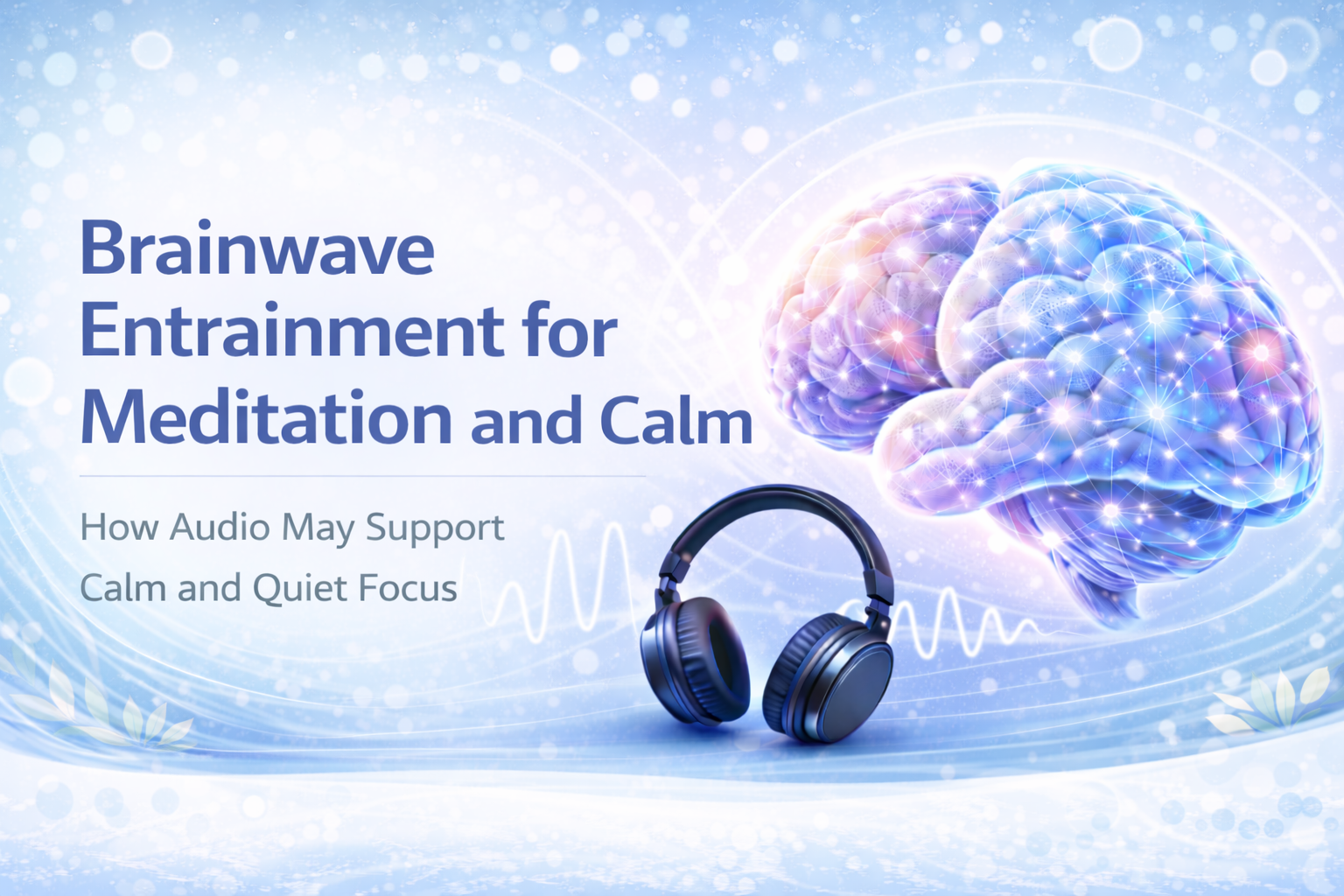
Part of the Brainwave Entrainment pillar in the Brain Health Hub.
Brainwave entrainment for meditation and calm refers to the use of rhythmic audio, such as binaural beats, isochronic tones, or other structured sound patterns, to help support a quieter and more settled mental state. Many people use these tools during meditation, breathwork, quiet rest, or evening wind-down routines because they want help slowing down mentally and reducing overstimulation.
The idea is simple. Repeated rhythmic sound may help create conditions that feel more stable, calming, and easier to settle into. For some people, that makes meditation feel more accessible. For others, it simply provides a relaxing audio backdrop that supports a calmer routine.
The most realistic way to think about brainwave entrainment for meditation is that it may help support the environment for calm and focus, but it is not a shortcut to instant inner peace, and it should not be treated as a replacement for healthy stress management, rest, or professional care when that is needed.
Related Page: What Is Brainwave Entrainment?
What Is Brainwave Entrainment for Meditation?
Brainwave entrainment for meditation usually involves audio designed to encourage a calmer, more inward-focused state. This may include binaural beats, isochronic tones, ambient meditation tracks, or layered soundscapes with rhythmic patterns.
These tools are often used to make it easier to begin a meditation session, stay with the practice, or reduce mental wandering. For beginners especially, having a steady audio anchor can feel more approachable than sitting in complete silence.
Instead of trying to “control” the brain, entrainment audio is better understood as a support tool. It may help you create a meditation-friendly setting by reducing the sense of scattered attention and giving the mind something simple to follow.
How Brainwave Entrainment May Support Calm
Feeling calm rarely comes from a single technique. Instead, it usually develops through several factors working together, including breathing, your environment, physical comfort, stress levels, and your ability to direct attention. Brainwave entrainment may act as one supportive tool within that broader process.
🧠 May Help By:
- Providing a steady sound pattern for the brain to follow
- Reducing the feeling of mental clutter for some listeners
- Adding structure to meditation sessions
- Creating a cue to slow down and unwind
- Supporting a more consistent relaxation routine
🌿 Keep Expectations Realistic
Research into brainwave entrainment is still evolving. While some people find it useful for relaxation and meditation, others notice little difference. Results vary depending on the individual, listening environment and the type of audio used.
Looking for More Structured Meditation Audio?
If you enjoy meditation audio, you may also want to explore dedicated brain audio platforms that combine binaural beats, isochronic tones, guided sessions and other relaxation techniques.
Compare Brain Audio Programs →What Types of Audio Are Used for Meditation and Calm?
Binaural Beats
Binaural beats are created when two slightly different tones are played separately into each ear. The brain may perceive the difference between the tones as a rhythmic beat. These are commonly used in meditation and relaxation audio.
Related Page: What Are Binaural Beats and How Do They Work?
Isochronic Tones
Isochronic tones use a single tone that pulses on and off in a steady rhythm. Some people prefer them, while others find them more noticeable or less soothing than binaural beats.
Related Page: Isochronic Tones vs Binaural Beats: Key Differences Explained
Ambient Meditation Audio
Some audio for meditation does not rely on binaural beats at all. It may include soft drones, nature sounds, singing bowls, gentle music, or breath-paced audio designed to reduce stimulation and support attention.
Guided Meditation Tracks
Guided meditations combine spoken instruction with calming sound. These may be especially useful for beginners who want more structure than sound alone provides.
Want a Structured Meditation Audio Program?
Many people begin with free meditation tracks, binaural beats, or calming audio on YouTube or streaming platforms. If you enjoy this style of listening, you may eventually want a more structured program designed for calm, relaxation, meditation, sleep, or focus.
Some dedicated brain audio platforms combine binaural beats with other techniques such as isochronic tones, guided sessions, ambient soundscapes, or subliminal messaging.
📘 Recommended Guide
Best Brain Audio Programs for Focus, Sleep & Relaxation →
- 🎧 Brainwave Shots for brainwave audio and relaxation sessions
- 🧠 Subliminal Guru for targeted focus, sleep and productivity programs
- 🎁 Inspire3 Gifts for free personal development and audio resources
- ✅ Which option may suit meditation, calm, sleep, focus and relaxation goals
Which Brain Waves Are Commonly Linked to Meditation?
In brainwave discussions, meditation is often associated with alpha and theta activity. Alpha is commonly linked with relaxed wakefulness and calm attention, while theta is commonly discussed in relation to deeper relaxation, inward awareness, and meditative states.
These are helpful reference points, but they should not be turned into rigid promises. Meditation is highly individual, and the brain does not operate in a perfectly simple one-wave model.
Related Page: Brain Waves Explained: Alpha, Beta, Theta, Delta and Gamma
Can Brainwave Entrainment Make Meditation Easier?
For some people, yes.
One of the hardest parts of meditation is getting started when the mind feels busy, restless, or overstimulated. Brainwave entrainment audio may help by making the experience feel less open-ended. The sound gives your attention something consistent to return to.
This can be useful if you:
- Find silence uncomfortable
- Struggle with racing thoughts
- Prefer structure during meditation
- Want a clear routine cue for calm
- Use meditation as part of stress support
That said, not everyone likes meditation audio. Some people find it helpful, while others prefer silence, breath awareness, or simple nature sounds.
What the Research Says
Research on meditation, mindfulness, and sound-based entrainment is promising in some areas, but it is still important to stay realistic. Meditation and mindfulness practices may help with stress, anxiety, and aspects of well-being, but evidence quality varies depending on the condition being studied and the type of practice used. Likewise, studies on binaural beats and auditory entrainment suggest possible benefits in areas such as relaxation, anxiety, sleep, and cognition, but findings remain mixed and do not support exaggerated claims.
If you want to reference external evidence inside the article, two reasonable sources are the NCCIH overview on meditation and mindfulness effectiveness and safety and a PubMed-indexed systematic review on binaural beats and brain oscillatory activity.
Brainwave Entrainment Is Not the Same as Meditation Skill
This distinction matters.
Audio may help support meditation, but it is not the same thing as developing meditation skill. Real meditation practice still involves attention, awareness, patience, and consistency. The sound may make it easier to begin, but it does not replace the practice itself.
A better way to see it is this:
- Meditation skill is what you build over time
- Brainwave entrainment audio is one tool that may help support the setting
How to Use Brainwave Entrainment for Meditation
If you want to try entrainment audio for meditation or calm, keep the process simple.
Choose one goal
Use the session for one clear purpose such as quiet sitting, breathwork, stress relief, evening calm, or recovery after a demanding day.
Start with short sessions
Ten to twenty minutes is a good starting point. This is long enough to notice how the audio feels without turning it into a chore.
Keep the volume low
The sound should feel supportive, not invasive. If you are paying more attention to the audio than to your breath or awareness, it may be too loud or too stimulating.
Use headphones if the track requires them
Binaural beats usually require separate tones to each ear, so headphones are normally recommended.
Related Page: Do You Need Headphones for Binaural Beats?
Return to a simple anchor
Use the sound as a support, but keep your main attention on the breath, body, or present-moment awareness.
Meditation Audio Fit Check
Who Might Benefit Most from Brainwave Entrainment for Calm?
May Be Worth Trying If You:
- Want help settling into meditation
- Prefer audio-guided calm over silence
- Feel mentally overstimulated
- Use meditation as part of stress support
- Want a simple, non-invasive relaxation tool
May Be Less Useful If You:
- Dislike repetitive sound
- Prefer silence during meditation
- Become distracted by headphones or audio texture
- Expect dramatic or instant results
Not sure which audio style suits you? Compare dedicated brain audio platforms for meditation, calm, sleep and focus in our guide to Best Brain Audio Programs for Focus, Sleep & Relaxation .
Can You Use It for Stress and Anxiety?
Some people do use meditation audio and binaural beats to reduce stress and support calm. For everyday stress, this may be a reasonable self-care practice. But it is important to stay measured in how this is described.
Brainwave entrainment is not a treatment for anxiety disorders, panic, trauma, or severe mental distress. If meditation or sound practices increase distress, agitation, dissociation, or emotional discomfort, stop and reassess. Some people do better with simpler grounding practices, movement, guided support, or professional help.
Is Brainwave Entrainment for Meditation Safe?
For many healthy adults, using calming audio at a moderate volume is generally low risk. But sensible use still matters.
Use extra caution if you:
- Have epilepsy or a seizure disorder
- Are highly sensitive to repetitive sound
- Experience headaches, agitation, dizziness, or discomfort
- Have a serious neurological or mental health condition
- Are using the audio in situations that require full attention
Meditation and mindfulness practices are often considered low risk, but they are not risk-free for every person in every context.
Related Page: Are Binaural Beats Safe? Benefits, Risks and What to Know
Common Mistakes to Avoid
Expecting instant transformation
Calm and meditation skill usually develop through repetition and environment, not one perfect audio track.
Using the audio too loudly
If the sound feels intrusive, it may work against the goal of calm.
Jumping between too many tracks
Consistency is often more useful than endlessly testing new frequencies.
Using sound instead of basic stress management
Audio can support a routine, but it does not replace sleep, boundaries, movement, hydration, and recovery.
Related Page: Brain Health Lifestyle: Sleep, Stress, Nutrition & Daily Habits
Calm Routine Reminder
Brainwave Entrainment Works Best Inside a Calmer Routine
The best results usually come when entrainment audio is part of a bigger calming system, rather than a one-off “quick fix.”
- Regular quiet time
- Breathwork
- Short meditation sessions
- Reduced digital stimulation
- Evening wind-down habits
- Healthy sleep patterns
Final Thoughts
Brainwave Audio Can Support Meditation — But It Works Best as a Practice Tool
Brainwave entrainment for meditation and calm may help some people settle into a quieter mental state, especially when used as part of meditation, breathwork, or evening wind-down routines.
The best approach is realistic and simple: use it as support, not as a miracle solution. Keep the volume comfortable, choose a calm setting, and notice how your own nervous system responds.
FAQs
Can brainwave entrainment help with meditation?
It may help some people settle into meditation by providing a steady audio pattern that supports focus and reduces mental clutter. It does not replace meditation practice itself.
What is the best brainwave entrainment for calm?
There is no single best option for everyone. Some people prefer binaural beats, while others respond better to isochronic tones, ambient sound, or guided meditation audio.
Do binaural beats help with calm?
They may help some listeners feel more settled or relaxed, especially when used in a quiet setting at a comfortable volume. Results vary.
Do you need headphones for meditation binaural beats?
Usually, yes. Binaural beats rely on each ear receiving a slightly different tone, so headphones are generally recommended.
Are meditation audio tracks the same as brainwave entrainment?
No. Some meditation audio includes brainwave entrainment, but many tracks use other calming elements such as music, guided speech, breath pacing, or nature sounds.
Can brainwave entrainment reduce anxiety?
It may support everyday calm or stress reduction for some people, but it is not a treatment for anxiety disorders or severe distress.
How long should you use brainwave entrainment for meditation?
A short session of about 10 to 20 minutes is a practical starting point. Comfort and consistency matter more than long sessions.
Can brainwave entrainment replace meditation practice?
No. It can support the setting for meditation, but it does not replace attention training, awareness, or regular practice.
Is brainwave entrainment safe for meditation?
For many healthy adults, moderate-volume use is generally low risk. People with seizure disorders, sound sensitivity, or certain neurological or mental health concerns should be more cautious.
What if brainwave audio makes me more restless?
Stop using that track. Some people respond better to silence, gentle music, nature sounds, or guided grounding practices instead.
Ready to Explore More Than Meditation Audio?
Brainwave entrainment is only one type of brain audio. If you’re interested in improving focus, productivity, sleep, relaxation or meditation, we’ve compared some of the most popular brain audio platforms and free resources available today.
Inside Our Comparison Guide
- 🧠 Brainwave Shots
- 🎧 Subliminal Guru
- 🎁 Inspire3 Gifts
- 💤 Which programs are best for sleep
- 🧘 Which programs suit meditation & relaxation
- 🎯 Which options are best for focus & productivity
- ✅ Which free resources are worth trying first
References
-
National Center for Complementary and Integrative Health. Meditation and Mindfulness: Effectiveness and Safety.
https://www.nccih.nih.gov/health/meditation-and-mindfulness-effectiveness-and-safety -
Chaieb L, Wilpert EC, Reber TP, Fell J. Auditory Beat Stimulation and Its Effects on Cognition and Mood States. Frontiers in Psychiatry. 2015.
https://www.frontiersin.org/articles/10.3389/fpsyt.2015.00070/full -
Garcia-Argibay M, Santed MA, Reales JM. Efficacy of binaural auditory beats in cognition, anxiety, and pain perception: A meta-analysis. Psychological Research. 2019.
https://link.springer.com/article/10.1007/s00426-018-1066-8 -
National Institute of Mental Health. Stress.
https://www.nimh.nih.gov/health/publications/stress
Medically Reviewed for Accuracy
This content has been reviewed for accuracy and clarity by the Cognitive Performance Hub Medical Review Team, using current research and evidence-based guidelines.
Our review process ensures that information related to brain health, cognitive performance, and wellness strategies aligns with current scientific understanding and best practices.
Brain Health Safety Note
This content is for educational purposes only and should not be used as a substitute for medical advice, diagnosis, or treatment.
If you are experiencing significant memory problems, confusion, sudden cognitive changes, neurological symptoms, or concerns about brain health, speak with a qualified healthcare professional promptly.
Never delay seeking medical advice because of something you read on this site.
Written by Cognitive Performance Hub Editorial Team
Our editorial team consists of health researchers and writers specializing in brain health, cognitive performance, and evidence-based wellness strategies.
We create clear, research-informed content designed to help readers improve focus, enhance memory, reduce brain fog, and support long-term cognitive health.
Affiliate Transparency
Some pages on Cognitive Performance Hub may include affiliate links. If you choose to make a purchase through one of these links, we may earn a small commission at no extra cost to you.
Our editorial content is created independently and is designed to prioritize clarity, evidence-informed information, and reader value.