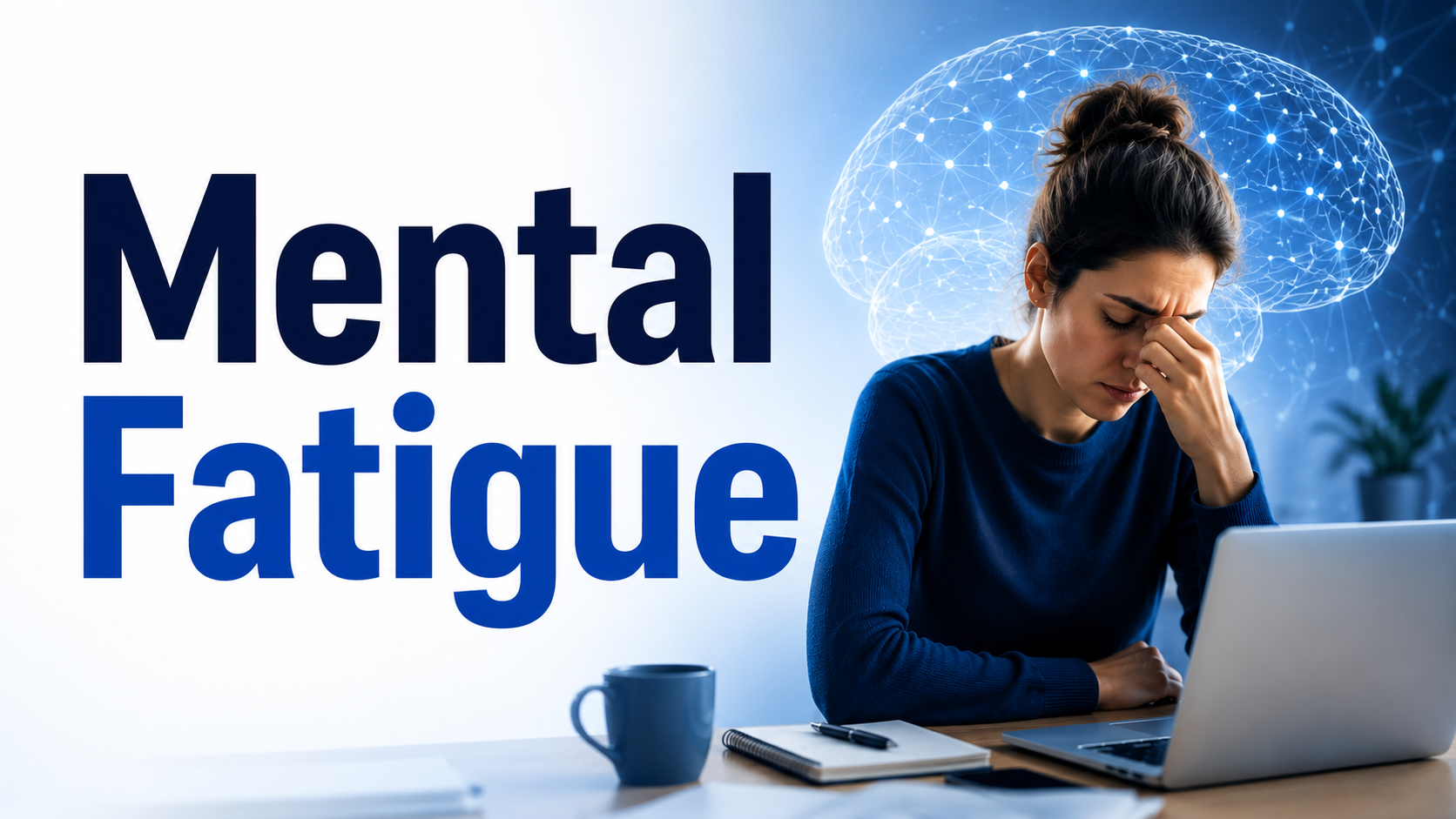
Mental fatigue is the drained, overloaded feeling that can develop after prolonged concentration, constant decision-making, emotional stress, intensive screen use, or long periods without meaningful recovery.
You may still be physically capable of working, but thinking feels slower, staying focused takes more effort, and even straightforward decisions can begin to feel mentally expensive.
Mental fatigue is not necessarily a sign that you are lazy, unmotivated, or incapable. It can be a signal that your brain has been sustaining cognitive effort for too long, managing too many competing demands, or operating without enough sleep and recovery.
This guide explains what mental fatigue feels like, what can cause it, how it differs from physical tiredness and brain fog, and which practical strategies may help you restore clearer thinking and more sustainable mental energy.
For a broader overview of concentration and attention, visit the Focus & Mental Clarity pillar.
Quick Overview
Mental Fatigue Is More Than Feeling Sleepy
It can affect concentration, decision-making, motivation, mental speed, emotional patience, and your willingness to continue a demanding task.
What Is Mental Fatigue?
Mental fatigue is a state of perceived cognitive tiredness that commonly develops during or after sustained mental effort.
It may appear after studying, writing, analysing information, solving problems, managing interruptions, making repeated decisions, handling emotionally demanding situations, or concentrating for long periods.
Researchers often describe mental fatigue as involving a growing sense of tiredness, reduced energy, and resistance to continuing the current task. It can also affect sustained attention and executive control—the mental processes involved in planning, prioritising, resisting distraction, and adjusting behaviour.
Mental fatigue is usually temporary. However, when it becomes frequent, severe, or difficult to recover from, it may indicate inadequate sleep, excessive workload, prolonged stress, illness, medication effects, or another underlying issue.
What Does Mental Fatigue Feel Like?
Mental fatigue can feel different from person to person. It may build gradually during the day or appear quickly after a particularly demanding period of concentration.
Common signs include:
- Feeling mentally drained or depleted
- Difficulty staying focused
- Slower thinking or information processing
- Rereading information without absorbing it
- Difficulty making even small decisions
- Reduced motivation to continue
- More frequent mistakes
- Forgetfulness or losing your train of thought
- Irritability or reduced patience
- Feeling overwhelmed by ordinary tasks
- Procrastinating on mentally demanding work
- Wanting stimulation but being unable to use it productively
- A heavy, cloudy, or “full” feeling in the mind
You may also notice that you become more reactive to notifications, noise, interruptions, or emotional stress as your mental energy declines.
Mental Fatigue vs Physical Fatigue
Mental fatigue and physical fatigue can occur together, but they are not identical.
Mental Fatigue
The Mind Feels Depleted
- Concentration feels difficult
- Decisions require more effort
- Thinking feels slower
- Motivation to continue declines
Physical Fatigue
The Body Feels Depleted
- Muscles feel tired or heavy
- Physical effort feels harder
- Energy for movement declines
- The body may need rest and recovery
It is possible to feel mentally exhausted while your body still has energy, or physically tired while your thinking remains relatively clear.
Mental Fatigue vs Brain Fog
Mental fatigue and brain fog frequently overlap, but the terms describe slightly different experiences.
Mental fatigue usually refers to the depletion that develops after prolonged cognitive demand. It often comes with reduced motivation and a growing desire to stop the task.
Brain fog is a broader, informal description of cloudy thinking. It may include forgetfulness, word-finding difficulty, slow recall, poor concentration, and reduced mental clarity.
Mental fatigue can contribute to brain fog, but brain fog may also be associated with poor sleep, illness, medication effects, hormonal changes, nutrition, blood sugar instability, or other health factors.
For a broader explanation, visit the Brain Fog pillar.
What Causes Mental Fatigue?
Mental fatigue is often caused by several overlapping demands rather than one single factor.
1. Prolonged Concentration
Working on an attention-intensive task for a long time can gradually increase the effort required to stay engaged.
This can occur during:
- Studying
- Writing or editing
- Data analysis
- Driving for long periods
- Complex problem-solving
- Detailed administrative work
- Monitoring tasks that require sustained vigilance
As fatigue builds, the mind may become less goal-directed and more easily captured by irrelevant stimulation.
2. Constant Task Switching
Moving repeatedly between email, messages, meetings, documents, applications, and unfinished tasks can make the day feel busy without allowing sustained mental progress.
Every switch requires the brain to disengage from one set of information and reconstruct another. This can increase cognitive load and leave you feeling depleted even when no single task seemed particularly difficult.
3. Too Many Decisions
Decision-making requires cognitive effort, particularly when choices involve uncertainty, consequences, competing priorities, or incomplete information.
A day filled with small decisions can gradually reduce the energy available for more important judgments later.
Creating standard routines, written priorities, templates, and default choices can reduce unnecessary decision load.
4. Stress and Emotional Strain
Stress can consume attention even when you are not actively working on the problem causing it.
Worry, threat monitoring, unresolved conflict, financial concerns, health anxiety, and emotional suppression may all compete with the task in front of you.
Research also suggests that stress can intensify fatigue during cognitively demanding work and contribute to cognitive overload.
Continue with Stress and Brain Function.
5. Poor or Insufficient Sleep
Sleep deficiency can affect alertness, decision-making, problem-solving, emotional regulation, and the ability to cope with changing demands.
A tired brain may reach mental overload more quickly because it begins the day with less capacity for sustained attention and self-regulation.
Signs that sleep may be contributing include:
- Waking unrefreshed
- Needing several alarms
- Strong daytime sleepiness
- Heavy caffeine dependence
- Difficulty thinking after poor sleep
- Snoring, gasping, or frequent night waking
Learn more in Sleep and Brain Health.
6. Digital Overload
Digital fatigue is not only about the amount of screen time. It can also result from the intensity and fragmentation of screen-based activity.
Video calls, notifications, social media, open tabs, fast-moving content, and constant message checking can keep attention in a reactive state.
This may leave little room for undisturbed thought or meaningful cognitive recovery.
7. Lack of Meaningful Breaks
A break does not always provide recovery.
Switching from work to scrolling, messaging, news, or video content may continue to load attention rather than allowing it to settle.
A restorative break is more likely to involve:
- Standing or walking
- Looking away from a screen
- Quiet breathing
- Drinking water
- Stretching
- Spending a few minutes outdoors
- Allowing the mind to be unstimulated
8. Hunger, Dehydration, or Unstable Energy
Long gaps between meals, inadequate fluids, heavy meals, or rapid energy changes can leave some people feeling sluggish, irritable, or mentally cloudy.
Rather than relying on repeated caffeine or sugary snacks, build a steadier foundation with regular meals, protein, fibre, appropriate hydration, and awareness of how different meals affect your clarity.
See Best Foods for Brain Health.
9. Anxiety, Depression, or Burnout
Mental fatigue can occur alongside anxiety, low mood, prolonged occupational stress, grief, and burnout.
In these situations, the fatigue may not resolve fully through ordinary productivity strategies because emotional and psychological demands remain active.
Seek professional support if mental fatigue occurs with persistent sadness, loss of interest, excessive worry, panic, hopelessness, major sleep changes, or substantial impairment in everyday functioning.
10. Illness, Medication, or an Underlying Condition
Persistent cognitive fatigue may sometimes be associated with:
- Sleep disorders
- Medication side effects
- Chronic pain
- Infection or post-illness recovery
- Thyroid conditions
- Anaemia or nutrient deficiencies
- Neurological conditions
- Long-term inflammatory or metabolic conditions
- Recovery after a head injury
This does not mean that frequent mental fatigue automatically indicates disease. It means persistent, worsening, or unexplained symptoms should not be dismissed as a lack of discipline.
Common Pattern
Mental Fatigue Often Builds in a Cycle
Long concentration, decisions, stress, and interruptions.
Thinking slows and distractions become harder to resist.
Tasks take longer and feel increasingly frustrating.
More screen use or forced effort continues the cycle.
Why Trying to Push Through Can Backfire
There are times when continuing for a short period is necessary. However, repeatedly forcing yourself through severe mental fatigue can reduce accuracy, increase frustration, and make the work take longer.
When fatigue is already affecting executive control, simply demanding more effort may not restore the quality of attention needed.
A more useful question is:
Does this task need more effort—or does my brain need recovery, clearer priorities, or fewer competing demands?
How Long Does Mental Fatigue Last?
The duration depends on its cause and severity.
Mild fatigue after concentrated work may improve after a proper break, food, water, movement, or a good night’s sleep.
Fatigue caused by prolonged stress, repeated sleep loss, burnout, illness, or an underlying condition may last much longer and require a broader recovery plan.
If your mental energy does not return after normal rest—or if small amounts of activity produce disproportionate exhaustion—consider discussing the pattern with a healthcare professional.
How to Recover From Mental Fatigue
1. Stop Adding More Stimulation
When mentally depleted, it is tempting to seek fast stimulation through social media, news, videos, or constant messaging.
This may feel easier than work, but it can keep attention activated and fragmented.
Try a quieter form of recovery instead.
2. Take a Screen-Free Break
Step away from the task and the screen for several minutes.
Walk, stretch, drink water, look outside, or sit quietly without replacing one information stream with another.
3. Move Your Body
Physical activity can support thinking, learning, problem-solving, memory, mood, and sleep.
You do not necessarily need a workout. A brief walk or movement break can help interrupt the feeling of cognitive stagnation.
Continue with Exercise and Brain Health.
4. Reduce the Number of Active Tasks
Write down everything competing for your attention, then select one priority.
This reduces the need to keep unfinished responsibilities active in working memory.
5. Make the Next Action Smaller
“Finish the project” is cognitively heavy.
“Draft the introduction” or “open the document and list three headings” is easier to enter.
6. Work in Shorter Blocks
Use a manageable work period followed by a genuine break.
The best duration varies. Twenty to forty-five minutes may be more realistic than demanding hours of uninterrupted concentration.
7. Protect Sleep
If fatigue has accumulated over several days, one short break will not replace adequate sleep.
Keep a consistent sleep schedule, reduce late-night stimulation, and investigate persistent daytime sleepiness or disrupted sleep.
8. Lower Unnecessary Decision Load
Use routines, prepared meals, recurring schedules, templates, checklists, and written priorities to reduce repeated low-value decisions.
9. Separate Deep Work From Communication
Avoid trying to complete focused work while continuously monitoring messages and email.
Create separate periods for concentrated work and communication whenever possible.
10. Review the Bigger Pattern
If mental fatigue returns every day, look beyond the immediate task.
Consider:
- Are you sleeping enough?
- Is your workload realistic?
- Are interruptions constant?
- Are you managing ongoing emotional stress?
- Do meals and hydration support steady energy?
- Are you taking genuine breaks?
- Did the fatigue start after an illness or medication change?
Practical Recovery
Try This 15-Minute Mental Reset
If your thinking remains severely depleted, the better choice may be longer recovery rather than another forced work block.
How to Prevent Mental Fatigue
Prevention is often more effective than waiting until concentration has completely collapsed.
Helpful habits include:
- Schedule demanding work during your clearest hours
- Protect uninterrupted periods for high-priority tasks
- Reduce unnecessary alerts and browser tabs
- Alternate highly demanding and lighter tasks
- Use written priorities instead of holding everything mentally
- Take breaks before severe fatigue develops
- Move regularly throughout the day
- Maintain consistent sleep and wake times
- Build lower-stimulation periods into your routine
- Set realistic limits on workload and availability
For a broader daily framework, visit Daily Habits for Better Brain Health.
Can Caffeine Help Mental Fatigue?
Caffeine may temporarily increase alertness for some people, but it does not remove the underlying need for sleep or recovery.
Using increasing amounts of caffeine to compensate for chronic fatigue may also interfere with later sleep, reinforcing the cycle.
Be cautious if caffeine causes anxiety, palpitations, digestive symptoms, headaches, or disrupted sleep.
Can Supplements Help?
Some supplements are promoted for mental energy, focus, or stress support. However, no supplement can reliably compensate for persistent sleep loss, unrealistic workloads, emotional strain, or uninterrupted cognitive demand.
Supplement effects depend on the ingredient, dose, product quality, existing deficiencies, medications, health conditions, and individual response.
Speak with a healthcare professional before starting a supplement if you take medication, have a medical condition, are pregnant, or are sensitive to stimulants.
For an evidence-conscious overview, see Best Nootropics for Focus.
When Should You Seek Medical Advice?
Arrange a medical assessment when mental fatigue:
- Is persistent or progressively worsening
- Does not improve after normal rest
- Interferes with work, study, driving, or daily functioning
- Began after an illness, head injury, or medication change
- Occurs with severe sleepiness or disrupted sleep
- Is accompanied by significant memory problems
- Occurs with persistent low mood, anxiety, or loss of interest
- Is associated with weakness, fainting, speech changes, or vision changes
- Feels disproportionate to the amount of activity performed
Seek urgent medical care for sudden confusion, one-sided weakness or numbness, facial drooping, difficulty speaking, loss of consciousness, severe new headache, or major new vision changes.
Final Thoughts
Mental Energy Needs Recovery, Not Just More Pressure
Mental fatigue commonly develops when concentration, decisions, stress, and interruption continue without enough meaningful recovery.
Short breaks, movement, better sleep, clearer priorities, fewer active tasks, and lower digital stimulation may help restore more sustainable mental energy.
Persistent or worsening fatigue should be assessed properly, especially when it affects safety, daily functioning, memory, mood, sleep, or physical health.
Take the Next Step
Build a More Sustainable Focus Routine
Learn how to improve concentration naturally or identify the underlying barriers that may be making it difficult to focus.
Frequently Asked Questions
What is mental fatigue?
Mental fatigue is a state of cognitive tiredness that can develop after sustained concentration, repeated decisions, emotional stress, intensive screen use, or other demanding mental activity.
What are the main signs of mental fatigue?
Common signs include poor concentration, slower thinking, reduced motivation, decision difficulty, irritability, more mistakes, forgetfulness, and a strong desire to stop mentally demanding work.
What causes mental fatigue?
Possible causes include prolonged cognitive effort, multitasking, stress, poor sleep, digital overload, insufficient breaks, unstable energy, anxiety, depression, illness, medication effects, and underlying health conditions.
Is mental fatigue the same as brain fog?
No. Mental fatigue usually describes depletion after cognitive effort, while brain fog is a broader description of cloudy or slowed thinking. The two commonly overlap.
How long does mental fatigue last?
Mild mental fatigue may improve after a genuine break, food, hydration, movement, or sleep. Persistent fatigue caused by chronic stress, illness, burnout, or sleep problems may last longer.
How do you recover from mental fatigue?
Reduce stimulation, step away from screens, move your body, drink water, lower the number of active tasks, sleep adequately, and restart with one small, clearly defined action.
Can lack of sleep cause mental fatigue?
Yes. Poor or insufficient sleep can impair alertness, decision-making, problem-solving, emotional regulation, and the ability to sustain cognitive effort.
Can stress make mental fatigue worse?
Yes. Stress can consume attention, disrupt sleep, increase cognitive load, and make mentally demanding tasks feel more exhausting.
Does caffeine fix mental fatigue?
Caffeine may temporarily improve alertness for some people, but it does not replace sleep or address excessive workload, stress, or inadequate recovery.
When should I seek medical advice for mental fatigue?
Seek medical advice if fatigue is persistent, worsening, unexplained, does not improve with normal rest, or occurs with memory problems, severe sleepiness, mood changes, neurological symptoms, or substantial impairment in daily life.
Focus & Mental Clarity
Recover Your Mental Energy and Rebuild Focus
Mental fatigue is often influenced by cognitive overload, poor sleep, stress, interruption, and inadequate recovery. Explore the next guides to build clearer, more sustainable concentration.
References
- Fatigue and Human Performance: An Updated Framework
- Understanding Mental Fatigue and Its Detection
- Mental Fatigue and the Control of Cognitive Processes
- Effects of Mental Fatigue on Attention
- Review of Visual Sustained Attention and Mental Fatigue
- National Heart, Lung, and Blood Institute: How Sleep Deficiency Affects Health
- Centers for Disease Control and Prevention: Physical Activity Boosts Brain Health
Medically Reviewed for Accuracy
This content has been reviewed for accuracy and clarity by the Cognitive Performance Hub Medical Review Team, using current research and evidence-based guidelines.
Our review process ensures that information related to brain health, cognitive performance, and wellness strategies aligns with current scientific understanding and best practices.
Written by Cognitive Performance Hub Editorial Team
Our editorial team consists of health researchers and writers specializing in brain health, cognitive performance, and evidence-based wellness strategies.
We create clear, research-informed content designed to help readers improve focus, enhance memory, reduce brain fog, and support long-term cognitive health.
Brain Health Safety Note
This content is for educational purposes only and should not be used as a substitute for medical advice, diagnosis, or treatment.
If you are experiencing significant memory problems, confusion, sudden cognitive changes, neurological symptoms, or concerns about brain health, speak with a qualified healthcare professional promptly.
Never delay seeking medical advice because of something you read on this site.
Affiliate Transparency
Some pages on Cognitive Performance Hub may include affiliate links. If you choose to make a purchase through one of these links, we may earn a small commission at no extra cost to you.
Our editorial content is created independently and is designed to prioritize clarity, evidence-informed information, and reader value.