Part of the Brainwave Entrainment pillar in the Brain Health Hub.
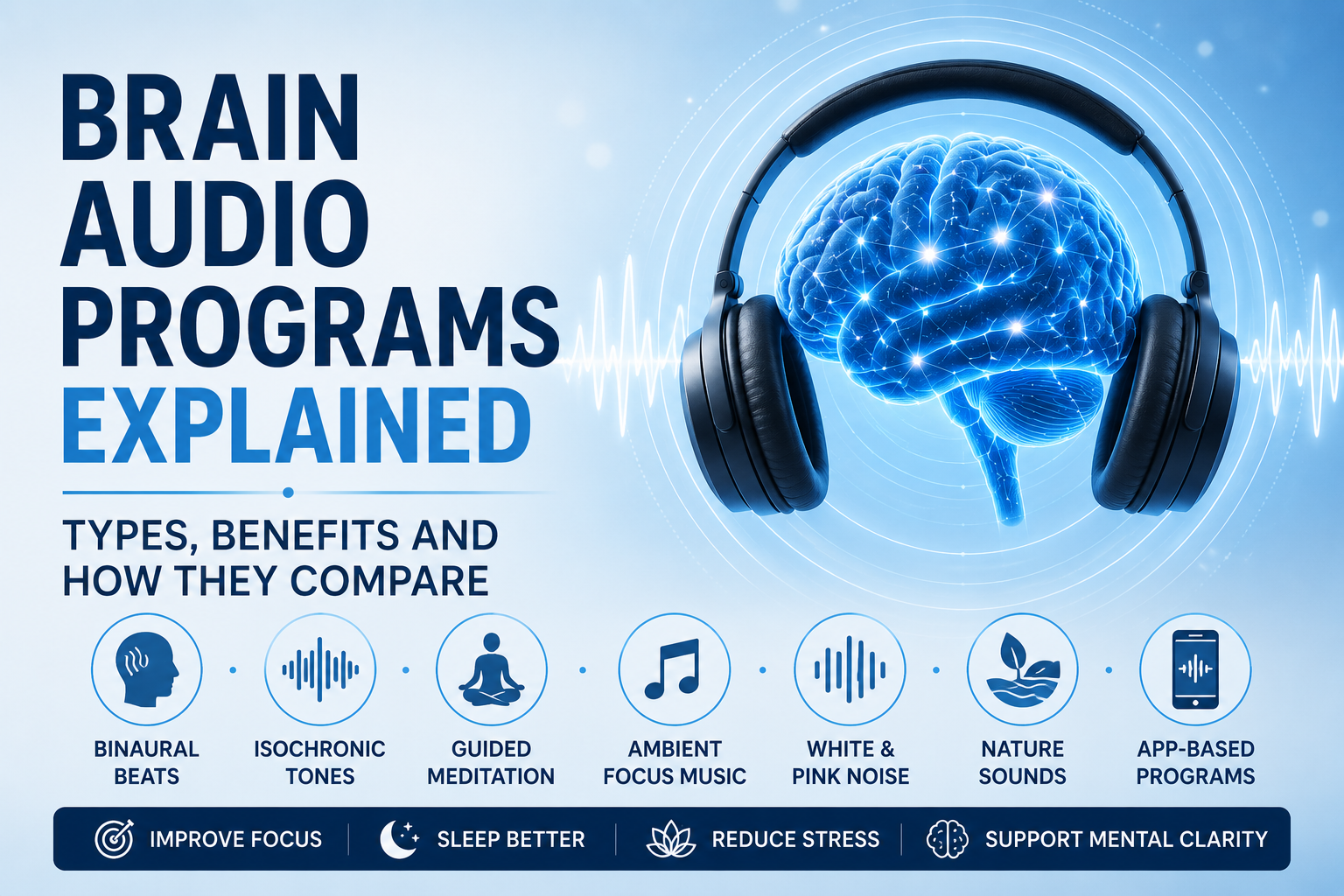
Brain audio programs are sound-based tools designed to support mental states such as focus, relaxation, meditation, sleep preparation, or calm. Some use structured rhythmic stimulation like binaural beats or isochronic tones. Others use guided meditation, ambient music, nature sounds, white noise, or layered audio experiences delivered through apps or recordings.
The biggest mistake people make with brain audio programs is treating them like magic. In reality, they are better understood as support tools. The right audio may help some people create a better environment for concentration, relaxation, or wind-down, but no program can replace sleep, stress management, healthy routines, or proper care when symptoms are ongoing.
This guide explains the main types of brain audio programs, what they are designed to do, how they compare, and how to choose a format that fits your real goal.
Related Page: What Is Brainwave Entrainment?
What Are Brain Audio Programs?
Brain audio programs are recorded or streamed sound experiences intended to influence how a session feels. Depending on the format, they may aim to support alertness, concentration, meditation, stress relief, sleep preparation, or a calmer mental pace.
Some programs are highly technical and built around rhythmic tones or frequency-based stimulation. Others are much simpler and rely on sound masking, guided breathing, soft music, or narrated relaxation.
That means “brain audio program” is a broad category, not one single method.
Main Types of Brain Audio Programs
Brain audio programs are not all the same. Some are tone-based and structured, while others are softer, more guided, or designed simply to mask distracting sound.
Binaural Beats
Two slightly different tones played separately into each ear. Often used for focus, calm, meditation, and sleep preparation.
Because they depend on separate tones going to each ear, headphones are usually recommended.
Related Page: What Are Binaural Beats and How Do They Work?
Isochronic Tones
A single tone that pulses on and off at a steady rate. Often feels more noticeable and more structured than binaural beats.
Some people prefer that stronger pulsing feel for focus, while others find it too noticeable for calm or bedtime use.
Related Page: Isochronic Tones vs Binaural Beats: Key Differences Explained
Guided Meditation Audio
Spoken instruction, breath pacing, body awareness cues, or visualization prompts designed to support relaxation, meditation, or mental reset. For many beginners, guided audio can make meditation feel more accessible than sitting in silence.
Ambient Focus Music
Low-distraction instrumental or ambient music designed for work, study, reading, writing, or deep focus sessions. The goal is usually not to “entrain” the brain in a technical sense, but to create a more usable mental environment.
White, Pink & Masking Audio
Continuous background sound such as white noise, pink noise, brown noise, rainfall, or fan-like masking audio used to reduce environmental distractions during sleep, focus, or relaxation.
Nature Soundscapes
Rain, ocean waves, streams, forest ambience, birds, or wind used for calm, sleep preparation, meditation, or background relaxation. For some people, they feel less artificial than tone-based tracks.
Layered App-Based Programs
Programs that combine multiple elements such as tones, ambient music, voice guidance, sound masking, and timers inside one system. Many are packaged inside apps with categories like focus, sleep, calm, meditation, memory, or productivity.
Some dedicated programs combine several of these audio types into one system. If you want to compare platforms rather than individual formats, visit Best Brain Audio Programs for Focus & Sleep & Relaxation.
What Brain Audio Programs Are Usually Used For
People use brain audio for different reasons, and the best program depends on the goal rather than the marketing.
Focus and Deep Work
Used during studying, writing, reading, planning, or cognitively demanding work to create a steadier listening environment.
Related Page: Binaural Beats for Focus: Can They Help Concentration?
Sleep Preparation
Used during the wind-down period before bed to support a calmer, lower-stimulation transition into sleep.
Related Page: Binaural Beats for Sleep: What to Know Before You Try Them
Meditation and Calm
Used to support quiet sitting, breathwork, body awareness, and a less mentally scattered state.
Related Page: Brainwave Entrainment for Meditation and Calm
Stress Relief and Mental Reset
Used after demanding work, information overload, or mentally exhausting days to create a calmer transition out of a high-pressure state.
How These Audio Types Compare
Each audio type has a different feel, a different best use, and a different level of headphone dependence.
If you want to compare actual platforms rather than just audio categories, see Best Brain Audio Programs for Focus, Sleep & Relaxation.
What the Research Suggests
The evidence base is different for different audio types, which is one reason this whole category is often misunderstood.
The binaural-beat literature remains mixed and methodologically inconsistent rather than definitive. If you want one direct source, see this systematic review on binaural beat stimulation and brain oscillatory activity.
For meditation-style audio, NCCIH notes that meditation and mindfulness may help in some contexts, but evidence quality, long-term effects, and the specific method being used still matter. A useful overview is here: Meditation and Mindfulness: Effectiveness and Safety.
For sleep-oriented sonic aids, a 2025 perspective in Sleep noted that music-based relaxation has demonstrated efficacy in improving sleep quality, while findings on ambient sounds such as white or pink noise remain more inconclusive. That matters because it shows not all audio categories have the same level of support.
The practical takeaway is simple: brain audio programs should be judged by the combination of evidence, personal response, comfort, and use case — not by marketing intensity alone.
How to Choose the Right Brain Audio Program
The best choice depends less on hype and more on your real goal.
If Your Goal Is Focus
Start with binaural beats, isochronic tones, or low-distraction instrumental audio. Use the one that helps you stay on the task.
If Your Goal Is Sleep
Try softer options such as guided sleep audio, music-based relaxation, nature sounds, or gentle sound masking.
If Your Goal Is Meditation
Guided meditation audio or softer binaural-beat-style tracks may be a better fit than more pulsed or technical audio.
If Your Goal Is Masking Noise
White noise, pink noise, nature sounds, or neutral ambient sound may make the most sense.
If You Want an All-in-One Experience
Layered app-based programs may suit you better because they combine audio types, categories, and timers in one system.
Looking Beyond Basic Brain Audio?
Understanding the different types of brain audio is a strong starting point, but many readers eventually want to compare actual platforms rather than individual audio styles. Some programs combine binaural beats, isochronic tones, guided sessions, ambient soundscapes, meditation audio, or subliminal messaging inside more structured listening systems.
If you want to compare real options for focus, sleep, relaxation, meditation, and productivity, our full guide breaks down several popular brain audio platforms and explains how they differ.
Do You Need Headphones?
That depends on the type.
Binaural beats usually need headphones because separate tones must reach each ear. Isochronic tones and most ambient audio do not depend on stereo separation in the same way. Guided meditation, music, white noise, and nature sounds can often be used through speakers or headphones depending on the setting.
Related Page: Do You Need Headphones for Binaural Beats?
Safety and Realistic Expectations
Most brain audio programs are best viewed as low-risk wellness tools when used sensibly, but that does not mean risk-free or automatically helpful for everyone.
The most practical safety issue is usually volume and listening duration, especially with headphones. WHO recommends keeping device volume below 60% of maximum and taking listening breaks when needed. Their guidance is here: WHO safe listening guidance.
It is also worth remembering that audio programs should not replace medical care, mental health support, or sleep treatment when those are genuinely needed.
Common Mistakes to Avoid
- Assuming one audio type works for everyone
- Using tracks too loudly
- Expecting dramatic instant effects
- Choosing audio based on hype rather than goal
- Ignoring comfort, especially with headphones
- Using audio to compensate for poor sleep, burnout, or chronic stress without addressing the basics
Final Thoughts
Brain audio programs include a wide range of tools, from binaural beats and isochronic tones to guided meditation, ambient focus music, sound masking audio, and nature-based soundscapes. They are not all designed for the same purpose, and they should not all be judged by the same standard.
The best program is not the one with the boldest claims. It is the one that fits your real goal, feels comfortable to use, and supports a healthier routine without becoming another source of overstimulation.
For the bigger picture, continue with the full Brainwave Entrainment pillar or return to the Brain Health Hub.
If you are ready to move from general explanations to actual platform comparisons, see Best Brain Audio Programs for Focus, Sleep & Relaxation.
FAQs
What are brain audio programs?
Brain audio programs are sound-based tools designed to support goals such as focus, relaxation, meditation, sleep preparation, or mental calm. They may include binaural beats, isochronic tones, guided meditation, music, noise masking, or nature audio.
Do brain audio programs really work?
Some may help some people in certain contexts, but the evidence differs by type and use case. They are better viewed as support tools than guaranteed solutions.
Are binaural beats and isochronic tones the same?
No. Binaural beats use slightly different tones in each ear, while isochronic tones use a single pulsing tone.
Do all brain audio programs need headphones?
No. Binaural beats usually do, but many other audio types such as guided meditation, music, white noise, and nature sounds can be used without headphones.
Which brain audio programs are best for focus?
Binaural beats, isochronic tones, and low-distraction instrumental audio are commonly used for focus. The best option depends on personal preference and how distracting the audio feels.
Which brain audio programs are best for sleep?
Many people prefer softer options such as guided sleep audio, music-based relaxation, nature sounds, or gentle sound masking. Personal comfort matters a lot.
Are brain audio programs safe?
For many people they are generally low risk when used at a comfortable volume and for sensible session lengths, but safe listening habits still matter.
Can brain audio programs replace meditation, therapy, or medical treatment?
No. They may support a routine, but they should not replace proper care or professional support when that is needed.
How do I choose the right brain audio program?
Start with your goal. Choose focus audio for work, calming audio for meditation, softer soundscapes for sleep preparation, and masking audio if your main problem is background noise.
What is the biggest mistake people make with brain audio programs?
The biggest mistake is expecting too much from them. They can support a better environment, but they do not replace healthy habits or fix everything on their own.
Ready to Compare Real Brain Audio Programs?
Now that you understand the main types of brain audio programs, the next step is comparing real platforms built for focus, sleep, relaxation, meditation, and productivity. Explore our full comparison guide to see how different brain audio options stack up.
References
-
Ingendoh RM, Perez P. Binaural beats to entrain the brain? A systematic review of the effects of binaural beat stimulation on brain oscillatory activity.
https://pubmed.ncbi.nlm.nih.gov/37205669/ -
National Center for Complementary and Integrative Health (NCCIH) — Meditation and Mindfulness: Effectiveness and Safety
https://www.nccih.nih.gov/health/meditation-and-mindfulness-effectiveness-and-safety -
World Health Organization (WHO) — Deafness and hearing loss: Safe listening
https://www.who.int/news-room/questions-and-answers/item/deafness-and-hearing-loss-safe-listening -
Vazzaz J, et al. Between sound and sleep: a perspective on Sonic Sleep Aids.
https://academic.oup.com/sleep/article/48/11/zsaf275/8251384
Medically Reviewed for Accuracy
This content has been reviewed for accuracy and clarity by the Cognitive Performance Hub Medical Review Team, using current research and evidence-based guidelines.
Our review process ensures that information related to brain health, cognitive performance, and wellness strategies aligns with current scientific understanding and best practices.
Written by Cognitive Performance Hub Editorial Team
Our editorial team consists of health researchers and writers specializing in brain health, cognitive performance, and evidence-based wellness strategies.
We create clear, research-informed content designed to help readers improve focus, enhance memory, reduce brain fog, and support long-term cognitive health.
Brain Health Safety Note
This content is for educational purposes only and should not be used as a substitute for medical advice, diagnosis, or treatment.
If you are experiencing significant memory problems, confusion, sudden cognitive changes, neurological symptoms, or concerns about brain health, speak with a qualified healthcare professional promptly.
Never delay seeking medical advice because of something you read on this site.
Affiliate Transparency
Some pages on Cognitive Performance Hub may include affiliate links. If you choose to make a purchase through one of these links, we may earn a small commission at no extra cost to you.
Our editorial content is created independently and is designed to prioritize clarity, evidence-informed information, and reader value.